Cinquale, Montignoso (MS), Italy — completed 2012 · 450 sqm residence · 5.000 sqm park
A primary residence on a 5.000 sqm park, facing the sea on the coast between Forte dei Marmi and the Apuan Alps. The brief began with an unusual reference: the family wanted a modern reinterpretation of an important historic villa they had known for generations — a house with the same scenographic presence, but redrawn in the language of contemporary architecture.
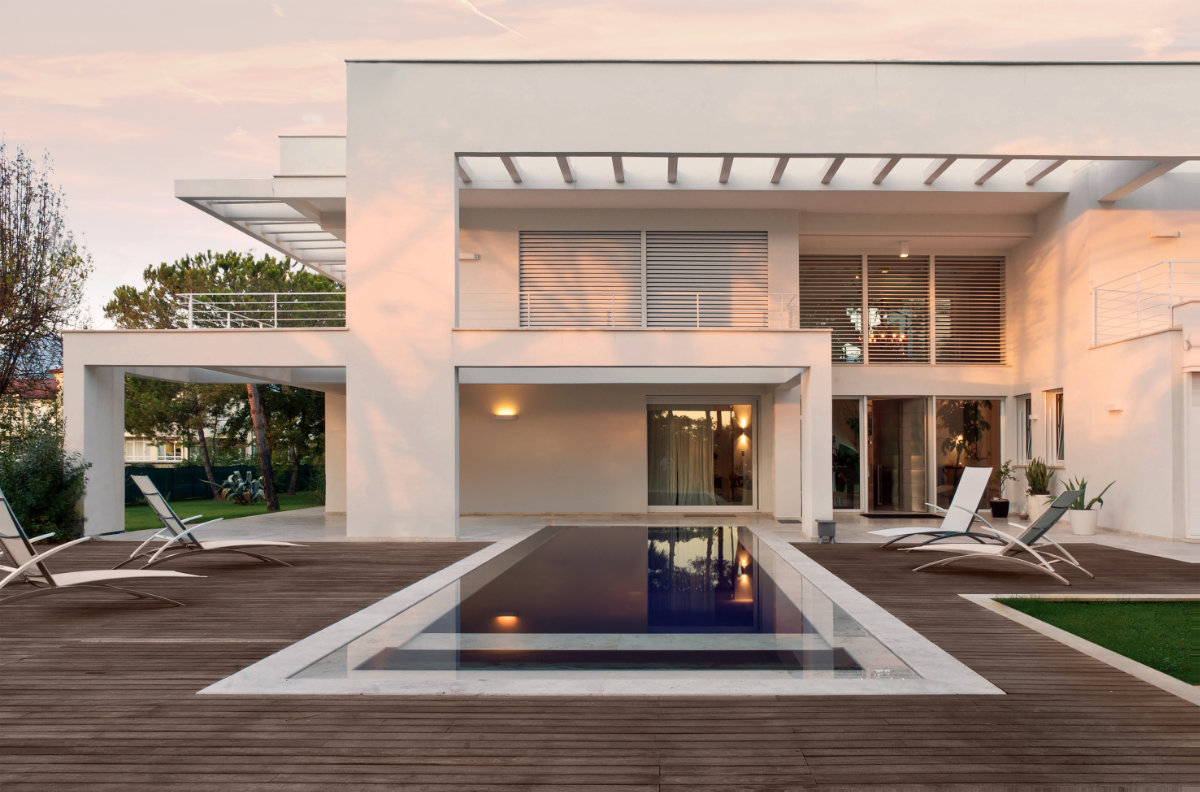
The result is a house that reads as a single horizontal gesture in the landscape, framed by the line of maritime pines on one side and the Apuan Alps on the other.
A site that asked for presence
Cinquale lies on the coast between Forte dei Marmi and Marina di Massa, on a stretch of shoreline where the Apuan Alps reach almost to the sea. The lot — 5.000 sqm of mature pine park — sits in a residential corridor where every house has held its own identity for decades.
The brief was specific. The clients wanted a house with the scenographic presence of a particular historic family villa they had known for years — not a copy of it, but a translation into the architectural language of today. A residence that would feel substantial without being heavy, contemporary without being neutral, anchored to the place without imitating what was already there.


The site itself, with its paesaggistic constraints and proximity to the water table, set the technical boundaries within which the language had to operate.

Two volumes, one architectural gesture
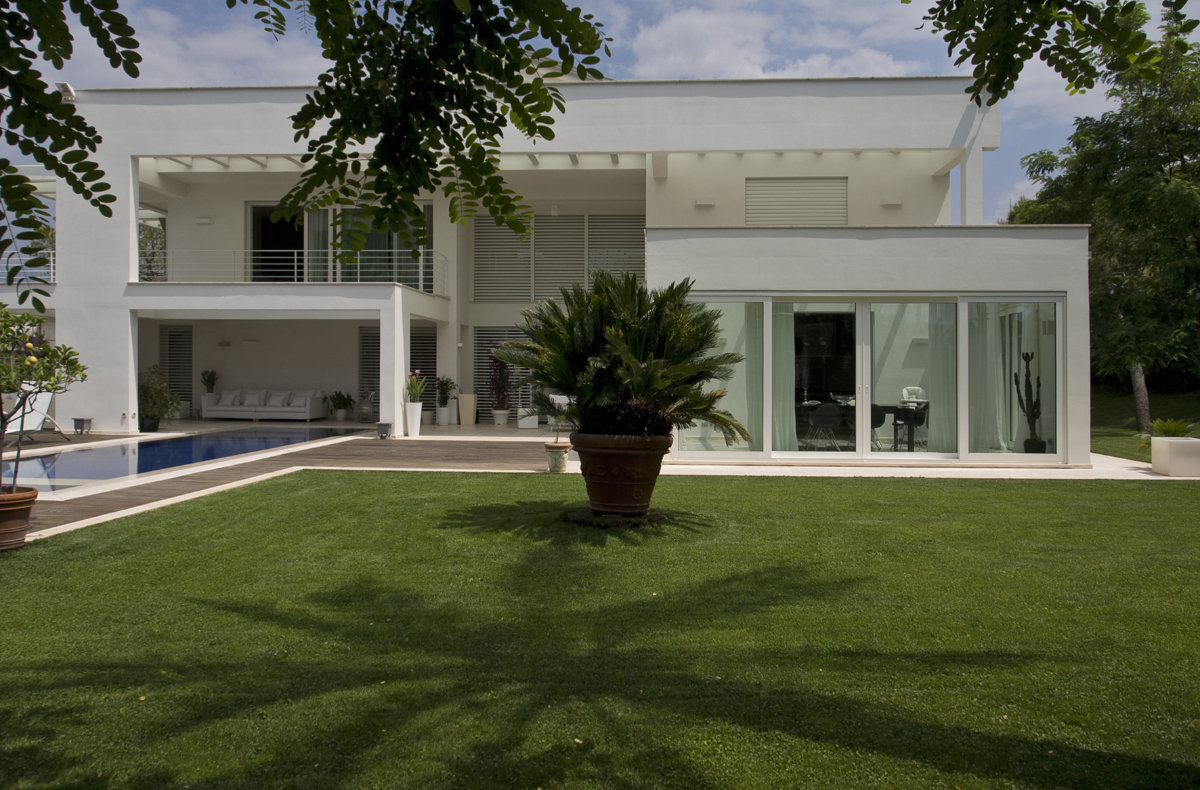
The plan organises the ground floor as two staggered volumes, distinct in function but read as a single architectural composition. One volume contains the living room, dining room, and the day-to-day services. The other holds the kitchen — separated by intention, so that the smells, the noise, the activity of cooking do not dilute the calm of the spaces designed for guests and conversation.
Above the two volumes, a planar pergola in reinforced concrete crosses the entire facade, binding them into a unified horizontal gesture. The eye reads continuity above; the plan delivers separation below.
The first floor accommodates the master suite and three bedrooms, organised around a corridor that overlooks the living room below through the double-height void on the front side. The spiral staircase that connects the two levels passes through this void — visible from below, walked through from above.


A regulation turned into a room
Between the two volumes of the ground floor sits an additional space: a glazed solar greenhouse, conceived as an extension of the dining room. It is, on the surface, simply a beautiful room — sunlit in winter, shaded in summer, looking out onto the park.
Architecturally, it is more than that. Italian regulation grants additional building area beyond the standard cap to spaces that provide a passive energetic contribution to the house. A glazed volume oriented to capture winter sun, ventilated and shaded in summer, qualifies as a “serra solare” — a solar greenhouse — and earns square metres that would otherwise be impossible to claim on this lot.
A literal reading of the regulation produces a thermal box. A more attentive reading produces a room. The greenhouse here is functional — it warms the house in winter through passive solar gain, it is screened in summer to avoid overheating — but it is also a place where the family eats lunch on cold sunny days in January, surrounded by glass on three sides.
The bonus square metres are not extra space. They are a second dining room that the lot would not otherwise have allowed.

A staircase as sculpture
The spiral staircase that connects the ground floor to the first floor is conceived as a sculptural object within the double-height void. Cast in reinforced concrete, clad in travertine, it rises through the volume as a single continuous surface — every tread, every riser, every detail expressed in the same stone.
It is visible from the entrance, from the living room below, and from the first-floor corridor above. From every viewpoint it reads as the central element of the interior — not a service device for moving between floors, but the formal centre around which the rooms organise themselves.


The longest beam in the province
The horizontal beam that crowns the principal facade — the one that defines the planar pergola and the upper edge of the main volume — is the structural element on which the entire architectural composition depends. Cast in reinforced concrete at a height of seven metres, it was, at the time of construction, the longest single-span reinforced concrete beam ever realised in the province of Massa-Carrara.
It allows the facade below to remain almost entirely glass: the double-height window on the front, the planar pergola above, the horizontal continuity unbroken by intermediate supports. Without that single beam, the facade would have required visible columns. With it, the architecture reads as a horizontal gesture suspended in the air.
The structure of the rest of the house is in reinforced concrete with timber roof beams. The basement, hosting a wine cellar and technical spaces, sits below the water table — built as a watertight cast, sealed against the water that permanently surrounds it.

Materials, light, framed views
The material palette is reduced and restrained: marble, glass, wood, white finishes. The mullions and transoms of the windows are slim aluminium profiles, white, calibrated to disappear into the geometry rather than to compete with the architecture.
The vertical and horizontal lines of the building frame the landscape with precision. From the living room, the view opens through the double-height window toward the garden and the pines beyond, with glimpses of the sea filtered through the trees. From the upper floor, the view extends further: the line of the Apuan Alps closes the horizon to the east. Every important opening corresponds to a specific view the architecture chose to frame.
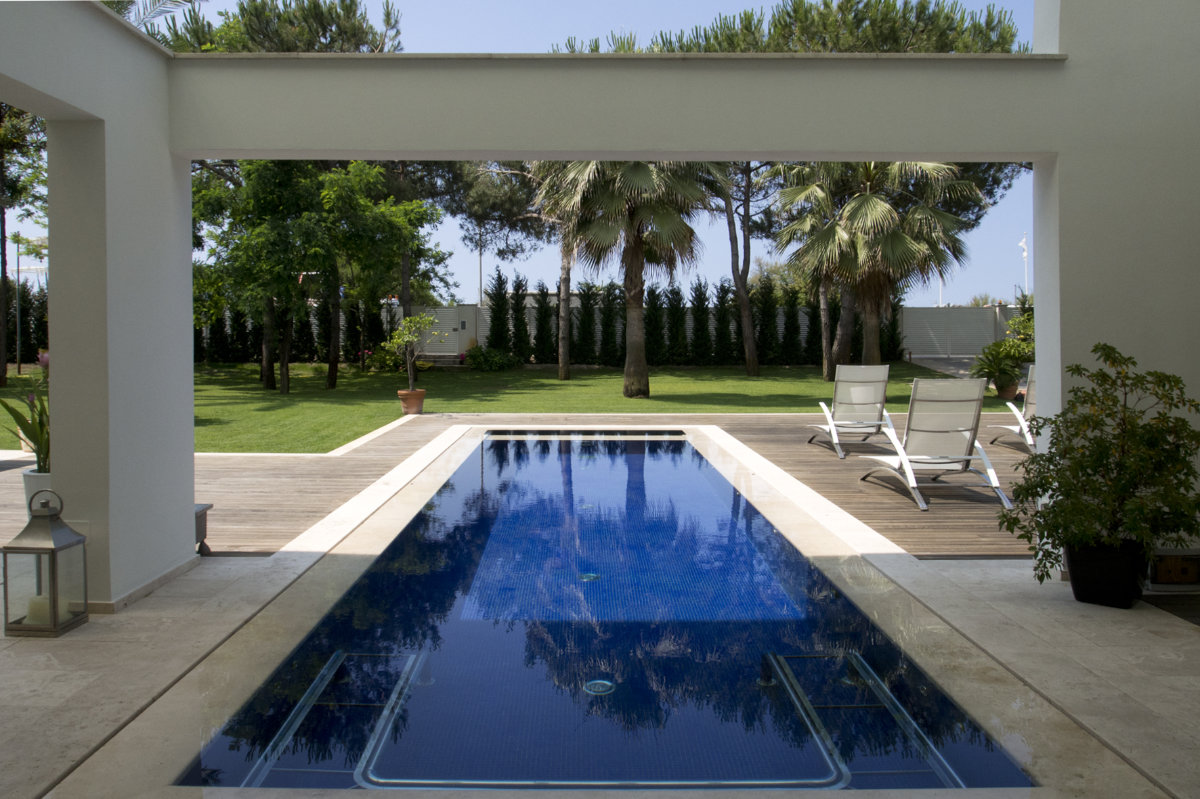
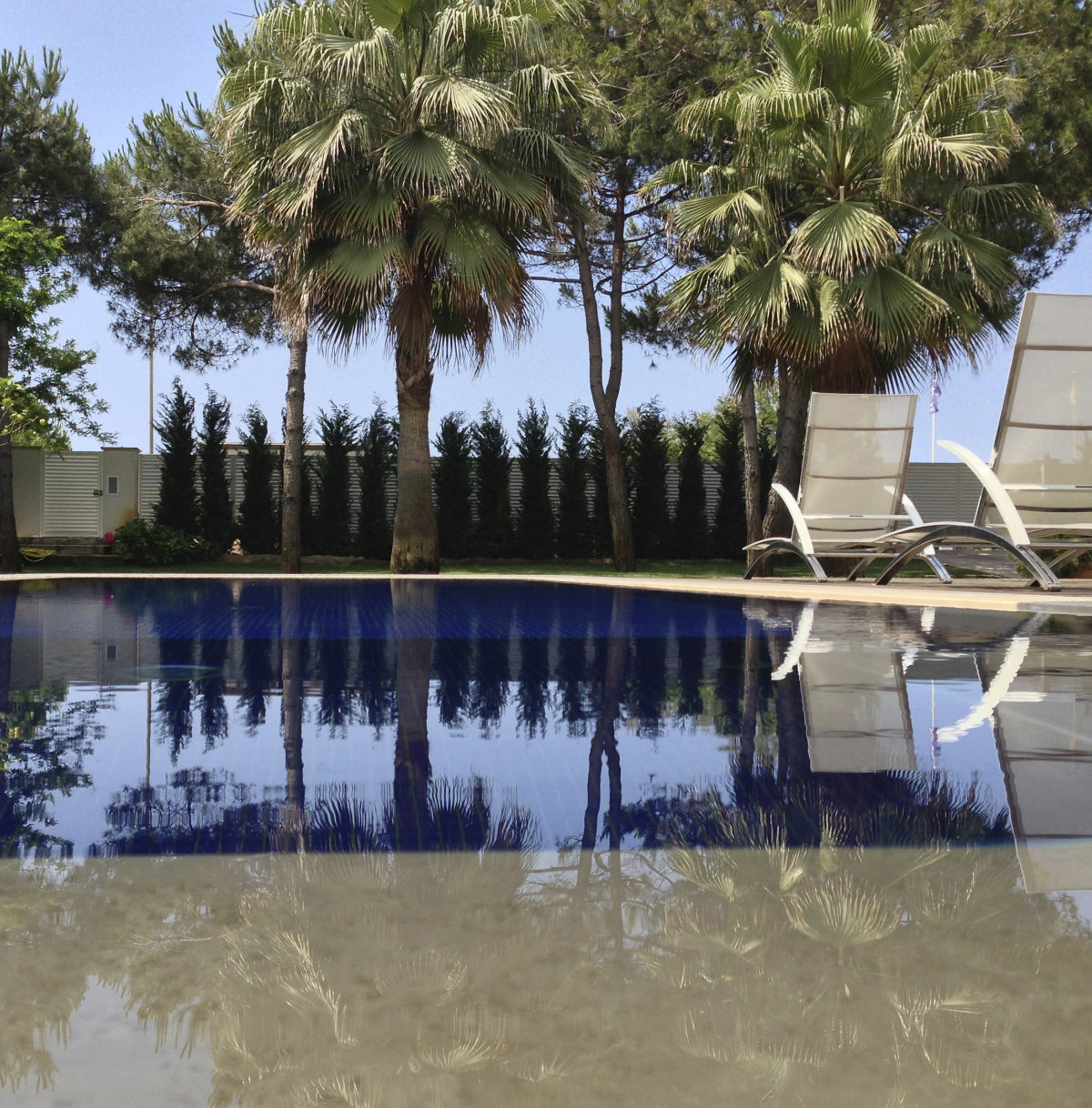
The garden and pool sit to the south of the volumes, accessible from both the living room and the solar greenhouse. The mature pine park surrounding the lot was preserved entirely — the architecture was designed to sit within the trees, not to clear them.

A wedding to deliver
The client was a real estate developer with one urgent constraint that no architectural drawing could account for: his daughter was getting married, and he wanted the wedding reception to take place in the new house. The construction had to be complete in ten months.
Ten months for a 450 sqm residence with double-height void, structural challenges, a record-length concrete beam, and a basement below the water table. The deadline shaped every decision — what could be detailed in time, what had to be simplified, which materials could realistically arrive within the construction window. None of this is visible in the finished house. All of it is the reason the finished house exists at all.
The wedding took place in the villa as planned. The shared decision-making between client and architect throughout the process — a defining method of the studio — made the speed possible without compromising the design.
The villa today
Thirteen years after completion, the villa is still the primary residence of the same family. Nothing of substance has been modified. The kitchen volume is still where it was placed; the solar greenhouse is still used as a winter dining room; the spiral staircase is still the formal centre of the interior. The horizontal beam still crowns the facade.
A residence that holds its design across a decade of inhabited life is, in the most concrete sense, a project that worked. There is no greater verification of an architectural choice than its absence of need to be revised.
More from the project



Discuss your residential project